
Member News ~ October 22, 2026

Dates & Events:
Oct 23 - One Last B.T.C.C.A. Outdoor Movie
Join The Berwick Theater & Center for Community Arts at Sponsler Park for a showing of Hocus Pocus 2! The FREE Admission movie will start at 6:30 and is presented in partnership with The Borough of Berwick & The Community Giving Foundation. All guests are encouraged to bring a chair & blanket. Check www.berwicktheater.org for Movie-&-LIVE Show info.
Oct 23 - Bloomsburg’s favorite Halloween activity, BOO!burg
5:00 pm - 7:30 pm Join the Exchange for Bloomsburg’s favorite Halloween activity, BOO!burg! Crafts and other activities, Trunk-or-Treat, Costume contest (ages 0-12), Face painting, Hot dogs and hot chocolate, Pumpkin drop, And more. If it rains, they will move everything into the Y’s gymnasium. Free and open to everyone of all ages! Venue: Seventh Street 570-317-2596 ExchangeArts.org
Oct 25 - Greenwood Friends School Invites Community to Second Annual Fall Festival
Greenwood Friends School invites families, friends, and neighbors to its Second Annual Fall Festival on Sunday, October 25, 2026, from noon to 3:00 p.m. on the school's campus in Greenwood Valley, between Millville and Orangeville. The outdoor festival will bring together local artists, makers, small businesses, and community organizations for an afternoon of food, creativity, hands-on activities, and community connection. For more information, visit www.greenwood-friends.org
Oct 29 - Gravity and Other Myths Returns to Weis Center with Piece Ten Thousand Hours
The Weis Center will welcome contemporary cirque ensemble Gravity and Other Myths on Thursday, October 29 at 7:30 p.m. in the Weis Center Concert Hall. Gravity & Other Myths (GOM) is the “jaw-dropping” circus company from Adelaide, Australia, who are known for its honest approach to performance, creating works that emphasize human connection and acrobatic virtuosity. For more information about this event, contact Lisa Leighton, marketing and outreach director, at 570-577-3727 or by e-mail at lisa.leighton@bucknell.edu.
Nov 19- Homeless in the Valley, hosted by CSO in partnership with Sen. Lynda Schlegel Culver.
Nov 24 - Bloomsburg Children’s Museum Invites Community to Annual Gingerbread House Competition at TreeFest
Participants can register for the 11th Annual Gingerbread House Competition at bit.ly/bcm-11th-gingerbread. Entries may be dropped off at the Caldwell Consistory from 10 a.m. to 6 p.m. Nov. 24 or 25. For more information about the Gingerbread House Competition, including entry information, visit the Bloomsburg Children’s Museum or contact the Museum at (570) 389-9206.
Nov 27 through Dec 6 - Be a Part of the Magic of TreeFest at BTE
Announcements:
SEKISUI KYDEX welcomed local students and educators to their South Campus for Manufacturing Day
More than 150 local students joined from Benton Area High School, Bloomsburg High School, Central Columbia Area High School, and Columbia-Montour Area Vocational-Technical School and discovered how many different paths can lead to a career in manufacturing. The visit highlighted roles including inspector/packer, extrusion operator, quality technician, color technician, production engineer, automation engineer, appLab™ engineer, graphic designer, and traditional business support positions.
Central Columbia FFA Advisor Receives State Citation
Mr. Doug Brown, Agricultural/Environmental Science Instructor and FFA Advisor at Central Columbia High School received a Pennsylvania House of Representatives State Citation for being awarded the Pennsylvania Farm Bureau and National Association of Agricultural Educators Distinguished Service to Agriculture Award. State Representative Robert Leadbeter attended the 2026 Agricultural Day at the 2026 Bloomsburg Fair inside the Keystone Building of the fairgrounds and awarded Mr. Brown this distinct honor.
Did You Miss Last Week's Member News? Here's News That's Still Timely:
SEKISUI KYDEX announces Marty Miller as President and Chief Operating Officer, effective November 1, 2026
Marty Miller joined SEKISUI KYDEX over 3 years ago as the Sr. VP of Operations, bringing more than 30 years of manufacturing experience to the organization. During this time, he has overseen IT and Automation, Innovation, and Production across three campuses, while also leading Supply Chain, Environmental Health and Safety (EHS), Continuous Improvement, and Maintenance. Prior to joining SEKISUI KYDEX, Miller served as Chief Operating Officer at Accupac in Mainland, Pennsylvania, providing him with extensive experience in operational leadership and organizational improvement. Visit www.kydex.com for more information.
MARC is excited to announce the Hopewell Park Pump Track, jumps line, and skills features are now open for public use
MARC’s staff will continue work at the site next week to finalize remaining details, but all newly installed features are complete and all park usage restrictions have been lifted. MARC thanks the American Ramp Company team and the many supporters who helped make the project possible.
Jon White-Spunner joins The Exchange as Development Director
The Exchange happily announces that Jon White-Spunner has joined the organization as our new Development Director. In this role, Jon will lead The Exchange’s fundraising efforts, broadening and deepening our support as we continue to bring the arts to all communities throughout our region.
Geisinger Behavioral Health Centers Accepts Award
They are honored to be recognized as the first recipient of The Joint Commission’s inaugural Care Team Award. This achievement reflects the dedication, collaboration and compassion their team brings to patients, families and communities every day. Congratulations to the incredible Geisinger Behavioral Health Centers Northeast team!
Millville Insurance provides chemo shirts to
soften the blow
Providing patients with a chemo shirt is a simple
way to show a little compassion to people when
their world sort of gets flipped on its head. If you are interested in supporting this mission, click here!
Oct 22- Danville After Dark
The Danville Business Alliance (DBA) invites the community to enjoy a family-friendly evening under the stars at Danville After Dark on Thursday, October 22, 2026, in Canal Park. Festivities begin at 6 p.m., followed by a free outdoor screening of Casper at 6:30 p.m. For more information, visit www.visitdanvillepa.org.
Oct 25 - Weis Center Presents Free World Music & Dance Performance: “Ori: An Exploration of Brazilian Dance and Music”
The Weis Center will present “Ori: An Exploration of Brazilian Dance and Music” on Sunday, October 25 at 2 p.m. in the Weis Center Concert Hall. The performance is free and tickets are not required. The runtime for Ori is 70 minutes with a 5-minute technical intermission. The performance order is as follows: Live Music – 25 minutes, 5-minute intermission, Dance – 45 minutes.
Oct 28 - BAYADA All-inclusive Trunk-or-Treat
Join BAYADA Bloomsburg for an all-inclusive trunk or treat at their Bloomsburg office (2041 Columbia Blvd) This event will take place from 5:00 PM - 7:00 PM. To participate as a trunk, contact 570-389-1568.
Oct 30 - Bloomsburg Public Library Sinister Soiree Author Talk & Book Signing
You’re invited to the book launch of Sinister Soirée: A Celebration Horror Anthology! Come to the Bloomsburg Public Library on Friday, October 30th at 7:00 PM to meet the authors and editor for an evening of celebration-themed horror, featuring readings, Q&A, and a book signing!
Oct 31 - The 5th Annual Movie Masquerade 5k Run/Walk
Pre-register by emailing thebtcca@gmail.com Register the day of between 8:30AM-9:55AM. The race will begin at 10AM. For more information visit The Berwick Theater and Center for Community Facebook page. The race will takeplace at Test Track Park, Berwick ... At the Pavilion near the Boat Launch Area
Oct 31 - Healthy Halloween at the Ferry Street Growers Market
Nov 4 - Columbia Montour Aging Office Celebrates National Caregiver Month
Come spend some time from 9AM - 1PM networking with other caregivers and learning about valuable local resources. Lunch will be provided. Join them at St Luke's Lutheran Church, Bloomsburg, PA. Register by Oct 26th by Calling Nancy at (570) 784 - 9272.
Nov 13 - The Federal Reserve’s 2026 Small Business Credit Survey is now open
Answers to these questions contribute to data that directly inform the Fed, federal government agencies, service providers, policymakers, and others—a public good ultimately benefiting your business and others like yours. The survey is open to businesses currently in operation, those recently closed, and those about to launch. All responses are confidential. Take the 12-minute survey before it closes on November 13, 2026
Recap: Legislative Lunch Forecast and Policy Takeaways
Source: Chris Berleth Columbia Montour Chamber of Commerce CEO/President

Who wins in November will help determine what moves in Harrisburg, what stalls in Washington, and what employers can expect as they hire, invest, and plan for the year ahead.
The Columbia Montour Chamber of Commerce’s October 13 legislative luncheon connected those political questions to local business priorities. Guest speakers Alan Novak and T.J. Rooney, known affectionately as “Pennsylvania’s Political Odd Couple,” brought decades of experience in Pennsylvania politics, a refreshing candor, and remarkably similar forecasts to a conversation about what comes after the election.
Novak, a former chairman of the Pennsylvania Republican Party, has advised governors and presidential campaigns. Rooney, a former chairman of the Pennsylvania Democratic Party, served seven terms in the Pennsylvania House of Representatives. The two co-founded the bipartisan Rooney Novak Isenhour Group and received Allegheny College’s Prize for Civility in Public Life in Pennsylvania in 2017.
The Chamber convened the discussion to help members understand the political outlook and identify opportunities to advance shared business priorities. The questions went beyond predicting winners: What would a change in party control mean for policy and its impact on business? Where would compromise still be necessary? How could employers help shape those decisions?
The Pennsylvania outlook and local business impact
“It’s not about a blue wave, it’s about a red undertow,” Novak said, describing dissatisfaction with affordability and President Trump’s influence as headwinds for Republican candidates in the lead-up to the November 3 midterm election.
Citing the Cook Political Report’s race ratings, both speakers described movement toward Democrats across a range of competitive races. Both predicted a substantial reelection victory for Governor Josh Shapiro and viewed a Democratic takeover of the Pennsylvania Senate as possible, potentially ending more than three decades of Republican control.
That broader forecast did not apply equally to every district. According to Rooney, “This race isn’t about really exciting Democrat candidates. No, in fact, there’s not a lot to get excited about here. This is about President Trump and the economy dragging down Republicans.” Both speakers specifically projected Congressman Dan Meuser to win decisively, illustrating how local Republican strength can persist alongside a wider shift toward Democrats.
Novak’s discussion of purchasing power helped explain the affordability concerns behind that forecast. Higher wages do not necessarily mean families are getting ahead when essential costs continue to rise. Employers experience that pressure through their own operating expenses and the need to offer wages that help employees keep up.
For businesses here, the statewide outcome could have consequences regardless of who wins locally. As Rooney put it, “Divided government is a good thing. Divided government breeds compromise.” Continued divided government would require agreement across party lines. While Democratic control of the governor’s office and both legislative chambers would give the party greater ability to advance its priorities, Rooney acknowledged that it would also bring challenges within the party, including navigating the role and influence of the Democratic Socialists of America (DSA) on the overall agenda.
Should Democrats gain control of the governor’s office and both legislative chambers, transportation funding is likely to emerge as a major Democratic priority in the next budget. For our region, the stakes include whether a statewide agreement addresses rural transportation needs and helps people get to work.
Beyond the issues discussed at the luncheon, the broader policy stakes include several areas where the Democratic-controlled House and Republican-controlled Senate have differed in recent years: increasing the minimum wage, expanding prevailing wage requirements, state spending and uses of the Rainy Day Fund, business and corporate taxes including combined reporting, energy, recreational marijuana, and the future of Pennsylvania’s Educational Improvement Tax Credit program, or EITC.
Childcare illustrates how the parties can recognize the same workforce challenge while approaching solutions differently. Republicans have emphasized regulatory reform, while Democrats have emphasized subsidies and support for the childcare workforce, including supplemental funding for teachers. Those differences matter to providers trying to sustain their operations and employers whose workers depend on reliable care.
During the luncheon, we discussed the Danville Child Development Center’s experience with playground inspection requirements and the expense of addressing them. The example brought the regulatory discussion close to home: an unexpected cost for a childcare provider has implications for a service working families depend on. It also demonstrated why lawmakers need to hear specific examples from the organizations affected by their decisions.
Potential changes to EITC carry similarly broad local implications. The program supports student programming through the Community Giving Foundation, For the Cause Teen Center, Bloomsburg Children’s Museum, the Chamber Foundation, Danville Child Development Center, and many others. Major changes could significantly affect educational opportunities for students throughout our region.
The federal outlook
The federal discussion pointed toward greater conflict and legislative gridlock if Democrats win control of the U.S. House. The speakers discussed the prospect of investigations and possible impeachment proceedings, with fewer opportunities for agreement on major legislation. That outlook differed from the possibility in Harrisburg, where unified Democratic control would significantly alter the way that state government has functioned in recent years.
Voting and staying engaged
The luncheon reinforced why participation matters. Start by voting. Consider how candidates’ priorities would affect your employees, your business, and the communities you serve. Encourage your employees to make their voices heard, too.
Then stay engaged. If a regulation, transportation gap, or childcare challenge is affecting your business, tell the Chamber what happened, what it cost, and what change would help. Rooney and Novak emphasized that specific examples give elected officials something concrete to address.
Whoever holds the majority next year, the Chamber’s responsibility remains the same: make sure the needs of Columbia and Montour County businesses are understood. We will continue bringing people together for thoughtful conversations across political differences, building relationships with elected officials from both parties, and advocating for policies that help our businesses and communities thrive.
Special thanks
Special thanks are due to PPL Electric Utilities, the luncheon’s premier sponsor, and Commonwealth University for hosting. PPL Regional Affairs Director Jonah Howe generously offered the company’s time at the podium to partner nonprofit Bloomsburg Children’s Museum. Board president Taryn Crayton shared exciting news: the timeline for the Museum’s planned NASA-sanctioned Challenger Learning Center has been significantly accelerated, bringing new opportunities for hands-on STEM education closer to reality for students throughout our region.
We’re grateful to our speakers, partners, and everyone who joined us for a candid conversation about the decisions ahead. From helping employers navigate public policy to investing in opportunities for our next generation, their involvement reflects a shared commitment to this region’s future. That gives us plenty of reason for optimism and plenty of good work to do together.
###
The Columbia Montour Chamber of Commerce represents local employers in supporting vibrant, sustainable communities in Columbia and Montour Counties. For more information about the region’s top businesses, visit www.columbiamontourchamber.com.

The Top Ten Lifestyle Benefits Employees Use Most (And Why They Matter)
 As healthcare costs continue to rise, many mid-sized employers are discovering that some of the most appreciated benefits aren’t medical at all. Lifestyle benefits…often voluntary and low-cost, can dramatically improve employee satisfaction by supporting real, everyday needs. Here are the ten lifestyle benefits employees actually use most.
First, mental health and wellness platforms consistently rank at the top, especially virtual therapy, coaching, and mindfulness tools. Second, financial wellness benefits, including budgeting tools and one-on-one coaching, help reduce stress that spills into the workplace. Third, flexible work arrangements, including hybrid schedules and flexible hour, remain one of the most valued “non-insurance” benefits.
Fourth, pet insurance has surged in popularity as pet ownership has grown. Fifth, legal services plans are heavily used for wills, estate planning, and family matters. Sixth, identity theft protection provides peace of mind in an increasingly digital world.
Seventh, student loan assistance or refinancing support resonates strongly with younger and mid-career employees. Eighth, caregiver support benefits, including elder-care and childcare resources, address a rapidly growing workforce challenge. Ninth, accident and critical illness coverage helps employees manage unexpected financial shocks. Finally, fitness and lifestyle stipends, from gym memberships to wellness apps, offer flexibility employees appreciate.
The common thread is simple: these benefits solve real problems. For employers with 50-150 employees, offering the right mix of lifestyle benefits can significantly boost perceived value, engagement, and retention…often without increasing employer-paid costs.
###
The Columbia-Montour Chamber of Commerce offers its members access to My Benefit Advisor as a solution for employee benefits, including voluntary offerings. For more information about My Benefit Advisor, visit our website at cmcc.mybenefitadvisor.com or contact Rob Higginbotham at (800) 377-3539.
Forest & Field Celebrates New Ownership with Ribbon Cutting and Open House
Source: Chris Berleth Columbia Montour Chamber of Commerce CEO/President
A large crowd of vendors, customers, family members, business partners, and Chamber members gathered on October 14th for a ribbon cutting and community open house celebrating Forest & Field Home Center LLC’s new owners, Derek and Janelle Steward. Held in partnership with the Columbia Montour Chamber of Commerce, the celebration took place at the business’s showroom at 1072 Alliance Park Drive in Bloomsburg.
State Representative Rob ert Leadbeter praised the Stewards for their investment in Forest & Field and their commitment to its customers and future. “Businesses like yours, with your wonderful brand partnerships and your incredible showroom, bring national attention to Columbia County and beautifully showcase what this region has to offer,” Leadbeter said.
Haeden Yough, Constituent Relations Specialist for Senator Lynda Schlegel Culver, also attended and offered congratulations on the senator’s behalf.
“At the Chamber, we love ribbon cuttings because they serve as reminders of investment, commitment, and growth,” said Chris Berleth, President/CEO of the Columbia Montour Chamber of Commerce. “We’re grateful to Derek and Janelle, their family and their team, and on behalf of the Chamber, we’re proud to offer our support for their continued success.”
“We are extremely excited about the current state of the business and look forward to seeing it grow. We have a great staff that is committed to expanding the business. We want Forest and Field Home Center to be a one stop shop for contractors and homeowners looking to complete projects,” said Derek Steward.
Following the ceremony, guests toured the showroom, met the Stewards and the Forest & Field team, and enjoyed food from Forge Pub and Eatery, along with a selection of wine and craft beer.
Inside the 10,000-square-foot home design showroom, customers can explore ideas for kitchens, bathrooms, and other living spaces. Professional designers guide projects from initial inspiration through design and product selection, while functional displays, a materials library, and consultation spaces help customers envision the possibilities for their homes.
The open house also continued Forest & Field’s tradition of serving as a community gathering place. The showroom has welcomed business after-hours events and nonprofit meetings, while its demonstration kitchen has hosted programs such as “Kids in the Kitchen” classes presented by the Bloomsburg Children’s Museum.
###
The Columbia Montour Chamber of Commerce represents local employers in supporting vibrant, sustainable communities in Columbia and Montour Counties. For more information about the region’s top businesses, visit www.columbiamontourchamber.com.
3 Tax Savings Manufacturers Shouldn’t Overlook
 As the end of the third quarter of 2026 approaches, it is a good time for manufacturers to start thinking about year-end tax planning. Manufacturers continue to face challenges, such as increased labor costs, supply chain uncertainty, and pressure to invest in the latest equipment and technology. Careful tax planning can be an effective way to offset some of these challenges. There are several potential options for a manufacturing company, such as accelerated depreciation on machinery/equipment purchases, R&D incentives, and energy credits. Implementing some of these strategies can help manufacturers reduce taxable income and set their businesses up for continued success.
The following three opportunities are especially relevant for manufacturers that are investing in machinery, automation, process improvements, domestic production, or facility upgrades in 2026.
1. Accelerated Expensing for Machinery and Equipment
Purchasing equipment is essential for any manufacturer. Manufacturers buying equipment, tooling, robotics, material-handling systems, computers, or certain software may be able to deduct eligible costs much faster through Section 179 expensing and bonus depreciation.
Section 179 expensing allows immediate, 100% tax deductions for the purchases of qualifying machinery and equipment. The maximum Section 179 deduction for 2026 is reportedly $2,560,000. There is a phaseout of the max deduction once qualified property placed in service for the year exceeds $4,090.000. Even with the phase-out rules, Section 179 expensing can be an effective tax-saving tool. However, Section 179 expensing cannot force a business into a taxable loss.
Bonus depreciation may also allow a 100% first-year deduction for qualifying property acquired and placed in service under current rules. Bonus rules have constantly changed over the years, but 100% bonus depreciation was made “permanent” starting January 19, 2025. Qualifying assets placed in service after this date can be 100% expensed via bonus depreciation.
Planning Tip: Section 179 expensing and bonus depreciation can both be used during the same tax year. Consult a tax professional to maximize these deductions. Keep in mind that not all state/local jurisdictions conform to accelerated depreciation methods.
2. R&D Costs & Credits
Some manufacturing businesses overlook research and development credits because they do not realize it can apply. Research and development (R&D) costs do not apply only to science labs and new inventions. Qualifying R&D activity can include improving production lines, testing new materials, designing prototypes, reducing scrap, improving throughput, automating manual steps, or solving technical uncertainty in product or process design.
Unlike in recent prior years, R&D costs are now eligible for immediate expensing. In years past, these costs were required to be capitalized and amortized; typically over a span of 60 months. The One Big Beautiful Bill Act (OBBBA) declared that these costs are now deductible in-full in the year they were incurred. Also, any unamortized R&D costs that were capitalized in prior years are eligible to be expensed in 2026. Taxpayers also have the option to split these deductions over 2 years. Unfortunately, this change can make compliance for state and local tax returns a bit complicated. Some states conform to Federal treatment while others do not.
Planning Tip: Try to document as much as possible; capture project notes, technical challenges, testing results, employee time, contractor costs, and supply costs as work occurs. Strong documentation makes the credit easier to support and helps identify eligible projects before details are forgotten.
3. Energy, Building, and Production Incentives
Manufacturers investing in energy-efficient equipment or facility improvements may qualify for valuable federal, state, or local tax incentives. These incentives can come in the form of tax deductions, rebates, credits, and more. Projects, such as upgraded HVAC systems, LED lighting, high-efficiency motors, and renewable energy installations, can provide both operating cost savings and tax benefits.
The landscape of these incentives has changed rather significantly with the implementation of the OBBBA. The unfortunate reality is that a lot of these incentives are trending towards expiration. But, as of 2026, there are still some valuable incentives available.
Planning Tip: Before beginning a project, evaluate available incentives to ensure all documentation requirements are met.
How Manufacturers Can Turn These Opportunities into Savings
- Build a 2026 capital expenditure list and identify expected placed-in-service dates.
- Map each major project to potential deductions, credits, rebates, and grants before contracts are finalized.
- Track R&D activities in real time, including employee time, test runs, prototypes, failed attempts, and technical uncertainties.
- Review state conformity rules for bonus depreciation, Section 179, credits, and treatment of R&D costs.
- Meet with tax advisors before year-end rather than waiting for return preparation.
The Bottom Line
For manufacturers, 2026 tax savings will depend less on a single deduction and more on timing, documentation, and coordination. Companies that connect operations, engineering, finance, and tax planning can turn everyday investments in equipment, innovation, energy efficiency, and inventory management into measurable tax advantages.
Please reach out to a member of our Manufacturing & Distribution team for more information on the topic outlined above. For more information regarding our Manufacturing & Distribution experience, visit our Manufacturing & Distribution industry page.
###
Member News ~ October 15, 2026
Dates & Events:
Oct 17 - Halloween and Fall Foliage Train Rides
Choose from two convenient morning Halloween excursions at 10:00 AM or 12:00 PM, featuring General Admission or Quiet Car seating options. Looking for a peaceful fall foliage journey? The 2:00 PM Fall Foliage two-hour train ride is perfect for anyone who wants to enjoy the scenery! This ride will not have any costumed characters, costume contests, or music.
Oct 17 - Dead Man Walking Distillery Comedy Show Benefits Local Fire Departments
Doors open at 7PM with free admission. Comedians Emmett O'Neill, Dan Danzy, Sam Grim, Joey B Donuts, Ray Cotolo, Steve, Max, and Ryan Hanlin. There will be a food truck onsite, with live music during the day. Click here for more information.

Oct 17 - Haunted History Tours at the Jackson Mansion
Step inside the Jackson Mansion for their famous haunted history tours of the 1st, 2nd, & 3rd floors offered: Oct. 17th, & Oct. 31st Tours at 5:00 pm & 6:30 pm each night. Special tour dates and times may be added to accommodate your group upon request. Call or visit the Ross & Boone Gift Shoppe to reserve: 570-520-4110. berwickhistoricalsociety.org
Oct 25 - Weis Center Presents Free World Music & Dance Performance: “Ori: An Exploration of Brazilian Dance and Music”
The Weis Center will present “Ori: An Exploration of Brazilian Dance and Music” on Sunday, October 25 at 2 p.m. in the Weis Center Concert Hall. The performance is free and tickets are not required. The runtime for Ori is 70 minutes with a 5-minute technical intermission. The performance order is as follows: Live Music – 25 minutes, 5-minute intermission, Dance – 45 minutes.
Oct 31 - The 5th Annual Movie Masquerade 5k Run/Walk
Pre-register by emailing thebtcca@gmail.com Register the day of between 8:30AM-9:55AM. The race will begin at 10AM. For more information visit The Berwick Theater and Center for Community Facebook page. The race will takeplace at Test Track Park, Berwick ... At the Pavilion near the Boat Launch Area
Oct 31 - Healthy Halloween at the Ferry Street Growers Market
Nov 4 - Columbia Montour Aging Office Celebrates National Caregiver Month
Come spend some time from 9AM - 1PM networking with other caregivers and learning about valuable local resources. Lunch will be provided. Join them at St Luke's Lutheran Church, Bloomsburg, PA. Register by Oct 26th by Calling Nancy at (570) 784 - 9272.
Nov 13 - The Federal Reserve’s 2026 Small Business Credit Survey is now open
Answers to these questions contribute to data that directly inform the Fed, federal government agencies, service providers, policymakers, and others—a public good ultimately benefiting your business and others like yours. The survey is open to businesses currently in operation, those recently closed, and those about to launch. All responses are confidential. Take the 12-minute survey before it closes on November 13, 2026
Announcements:
SEKISUI KYDEX announces Marty Miller as President and Chief Operating Officer, effective November 1, 2026
Marty Miller joined SEKISUI KYDEX over 3 years ago as the Sr. VP of Operations, bringing more than 30 years of manufacturing experience to the organization. During this time, he has overseen IT and Automation, Innovation, and Production across three campuses, while also leading Supply Chain, Environmental Health and Safety (EHS), Continuous Improvement, and Maintenance. Prior to joining SEKISUI KYDEX, Miller served as Chief Operating Officer at Accupac in Mainland, Pennsylvania, providing him with extensive experience in operational leadership and organizational improvement. Visit www.kydex.com for more information.
MARC is excited to announce the Hopewell Park Pump Track, jumps line, and skills features are now open for public use
MARC’s staff will continue work at the site next week to finalize remaining details, but all newly installed features are complete and all park usage restrictions have been lifted. MARC thanks the American Ramp Company team and the many supporters who helped make the project possible.
Jon White-Spunner joins The Exchange as Development Director
The Exchange happily announces that Jon White-Spunner has joined the organization as our new Development Director. In this role, Jon will lead The Exchange’s fundraising efforts, broadening and deepening our support as we continue to bring the arts to all communities throughout our region.
Geisinger Behavioral Health Centers Accepts Award
They are honored to be recognized as the first recipient of The Joint Commission’s inaugural Care Team Award. This achievement reflects the dedication, collaboration and compassion their team brings to patients, families and communities every day. Congratulations to the incredible Geisinger Behavioral Health Centers Northeast team!
Millville Insurance provides chemo shirts to
soften the blow
Providing patients with a chemo shirt is a simple
way to show a little compassion to people when
their world sort of gets flipped on its head. If you are interested in supporting this mission, click here!
Did You Miss Last Week's Member News? Here's News That's Still Timely:
Oct 15 - Bucknell Economics Professor Offers an Evening of Sufi Fusion at the Weis Center
The Weis Center will welcome Shahram Azhar and his Quartet on Thursday, October 15 at 7:30 p.m. in the Weis Center Atrium. The performance is titled, “From the Wound to the Dawn” and will be an evening of raag, thumri and ghazal. For more information about this event, contact Lisa Leighton, marketing and outreach director, at 570-577-3727 or by e-mail at lisa.leighton@bucknell.edu.
Oct 17 - Join Central Columbia FFA at Rohrbach's Farm
The Central Columbia FFA students will be there from 11:00am - 7:00 PM and includes pumpkin painting, ballon art, seasonal treats, face painting, a corn maze & more!
Oct 22 - The First Step: Starting a Business in Pennsylvania
The Wilkes University SBDC is helping aspiring Columbia County entrepreneurs take the first step toward business ownership. Join them for The First Step: Starting a Business in Pennsylvania, a no-cost, in-person seminar covering the essentials you need to move your idea forward, including business structures, licensing and registration, financing, business planning, financial projections, and more. Plus, bring your questions for Q&A! Thursday, Oct. 22 11 a.m.–noon The Hub at Mulberry Mill (160 W. 6th Street, Bloomsburg) Register today
Oct 22 - Free WEBINAR: Reading Between the Lines: Questions Every Nonprofit Leader Should Ask About Financial Reporting and Form 990
Join McKonly & Asbury’s Nonprofit specialists Jim Shellenberger, Mark Welliver, and Alyssa Irish at 2:00 PM for an engaging discussion on what nonprofit leaders, board members, finance professionals, and other stakeholders should be looking for when reviewing auditor and accountant reports, financial statements, and tax filings. Registration Link: WEBINAR: Questions Every Nonprofit Leader Should Ask | Nonprofit CPA
Oct 22- Danville After Dark
The Danville Business Alliance (DBA) invites the community to enjoy a family-friendly evening under the stars at Danville After Dark on Thursday, October 22, 2026, in Canal Park. Festivities begin at 6 p.m., followed by a free outdoor screening of Casper at 6:30 p.m. For more information, visit www.visitdanvillepa.org.
Oct 28 - BAYADA All-inclusive Trunk-or-Treat
Join BAYADA Bloomsburg for an all-inclusive trunk or treat at their Bloomsburg office (2041 Columbia Blvd) This event will take place from 5:00 PM - 7:00 PM. To participate as a trunk, contact 570-389-1568.
Oct 30 - Bloomsburg Public Library Sinister Soiree Author Talk & Book Signing
You’re invited to the book launch of Sinister Soirée: A Celebration Horror Anthology! Come to the Bloomsburg Public Library on Friday, October 30th at 7:00 PM to meet the authors and editor for an evening of celebration-themed horror, featuring readings, Q&A, and a book signing!
A New Chapter for Greenwood Friends School: Jessica Temple Named Head of School
Greenwood Friends School is pleased to announce Jessica Temple as its new Head of School, effective October 1, 2026. Temple brings to the role a strong background in organizational leadership and a deep commitment to the students, families, faculty, and staff who make up the Greenwood community. To learn more about Greenwood please visit greenwood-friends.org
Swift Kennedy Shares Live Well, Work Well - October Newsletter
This month's Live Well, Work Well Newsletter highlights this year's flu season, how your body reacts to daylight saving time and whether sweating burns calories. Download now
UNITED WAY’S “DIAPER DASH” KICKS OFF ACROSS FIVE COUNTIES
Susquehanna Valley United Way (SVUW) has once again launched its annual Diaper Dash. Throughout the month of October, their team will collect diapers and wipes so families have one less thing to worry about as the colder months approach. Find addresses and additional drop-off locations: svuw.org/diaper-dash-2026
B.I.D.A. Welcomes Three New Members to Board of Directors
Individual Member Lynda Culver Shares Alice's Law Update
Alice’s Law moved forward this week when the Senate Aging and Youth Committee unanimously advanced Senate Bill 807 as amended. The bill would establish a statewide Older Adult Abuse Registry to help prevent individuals convicted of abusing older or care-dependent Pennsylvanians from moving between care settings without that history being known. Learn more about Alice’s Law and elder abuse awareness on SenatorCulver.com
Small Businesses Report Strong Health Despite Inflation Concerns
 Small business confidence improved in the third quarter as owners reported stable business health and greater comfort with cash flow, according to the latest Justworks and U.S. Chamber of Commerce Small Business Index.
The Q3 2026 Index score rose four points to 70.5, just below the record 72.0 recorded one year ago.
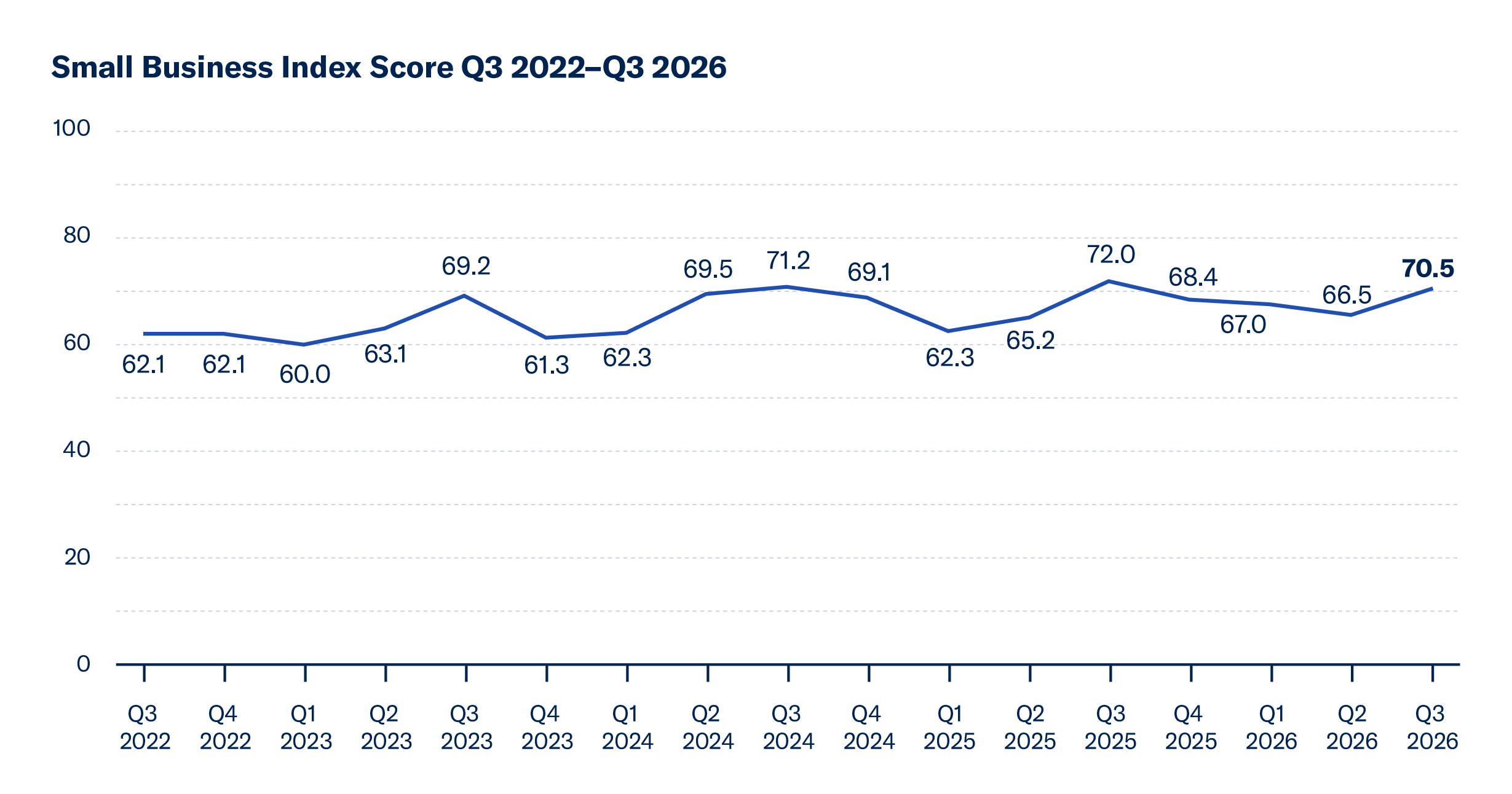
Image provided by US Chamber
Strong Business Health and Good Cash Flow
According to the poll, small businesses report stable business health and cash flow.
In fact, seven in ten (71%) small businesses say their own business is in good health. Meanwhile, 72% of small businesses are comfortable with their cash flow, and the share of small businesses rating their health as “very good” rose eight points to 35%.
Few See Good Economy and Inflation Challenges Persist
The good feelings about their own small business do not automatically translate into optimism about the overall economy.
Small business views of the national and their local economies remain muted: Just 27% of small businesses believe that the national economy is in good health (in line with Q2 2026), while 33% say the same about their local economy (unchanged from last quarter).
In addition, inflation remains the most significant obstacle facing small businesses this quarter, cited by 54% of respondents and marking the third consecutive quarter where at least 50% have cited it as a top challenge.
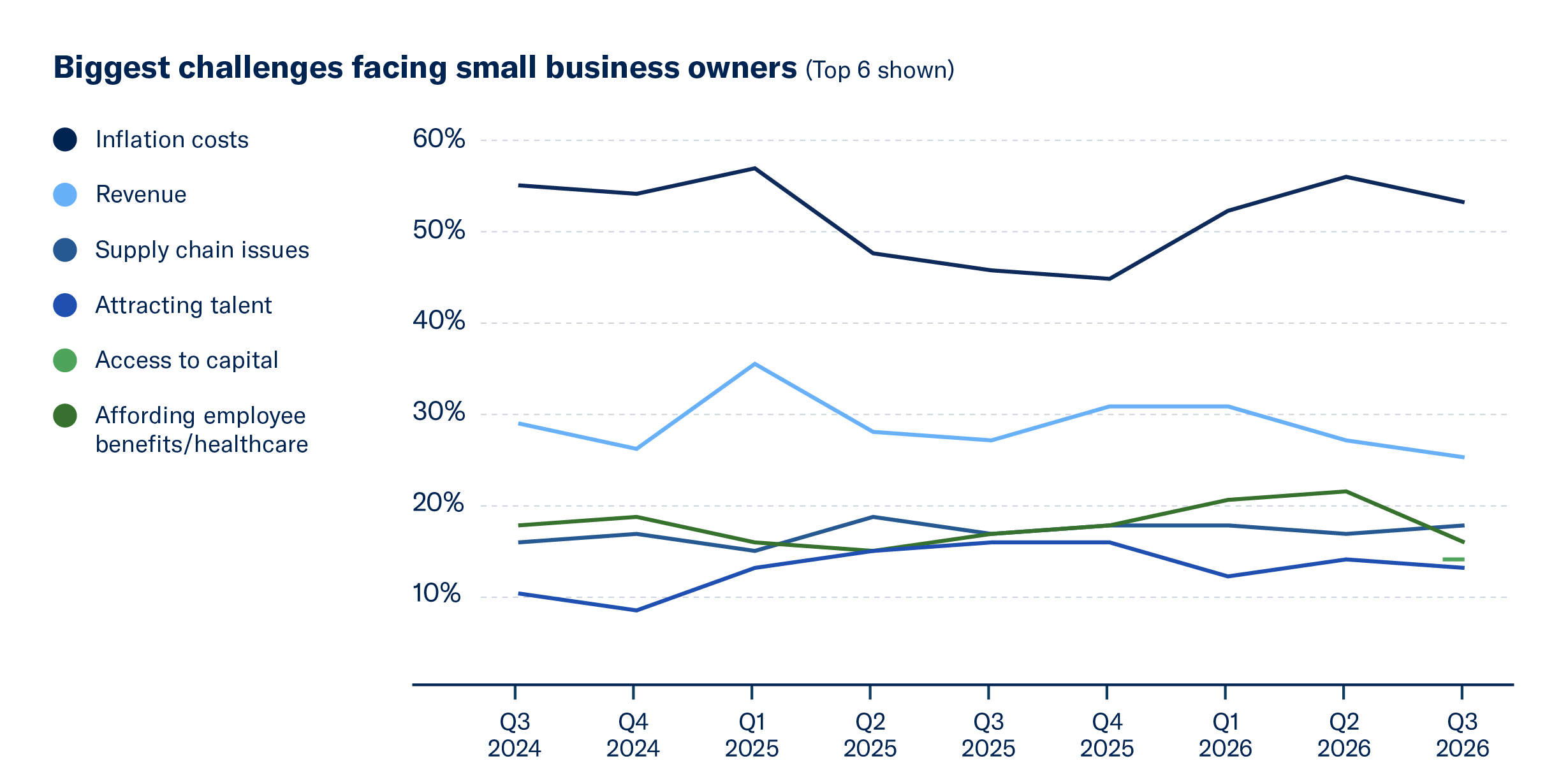
image provided by US Chamber
Despite this, 62% of small businesses expect higher revenue in the coming year, while 38% plan to increase investment and 36% expect to add staff.
“Inflation doesn't stay contained to the business side of the ledger; it follows employees home, showing up in their grocery bills, rent, and gas prices. When people are financially stretched outside of work, it shows up inside work too: more stress, less focus, and less capacity to bring their best selves to the job,” said Stevie Straka, VP of people at Blumira, an Ann Arbor, Michigan-based IT security operations company running their business on Justworks.
More Small Businesses Offering Key Employee Benefits
This quarter’s report also examines the investments small businesses are making in their employees.
Seven in ten small businesses offer at least one benefit to full-time employees, with more providing key benefits than last year:
- Health insurance: 46% (up from 41% last year)
- Paid vacation: 40% (up from 30%)
- Dental and vision coverage: 31% (up from 21%)
- Retirement plans: 27% (up from 22%)
Rising costs (35%) and limited budgets (34%) were the most commonly cited barriers to offering benefits.
Despite cost pressures, nearly all small businesses agree that employee benefits are important for demonstrating care for employees (95%), retaining employees (94%), and attracting employees (89%).
The Q3 survey was conducted between August 4–18, 2026. For more findings from this quarter, and to explore years of small business data, visit here.
###
The Columbia Montour Chamber of Commerce is a proud member of the U.S. Chamber of Commerce and an active part of the U.S. Chamber Federation of small and regional chambers, which routinely provides content like the article above. The content above does not constitute legal, accounting, tax, or other professional advice but is for general informational purposes. For accurate, complete advice, readers are encouraged to consult with qualified legal, accounting, or other professional advisors before making any decisions based on the information provided. If you need help finding qualified help, please contact the Chamber for a list of our members.
Mergers & Acquisitions – What Are the Tax Considerations? Part 3
Part 1: Asset Deals Part 2: Stock Deals
This is the third addition in our series of articles on the tax considerations related to mergers and acquisitions. January’s article covered asset deals, while the article in March discussed stock deals.
 Today’s article will tackle the question of what if someone wants both? Society tends to have ever-increasing desire to get everything they want all at once, is it any surprise that acquisitions would be any different? Can the best of both worlds really be possible? The answer is… kind of. Here’s how.
The Asset and Stock Deal Solution
As previously discussed, buyers generally want to buy assets – but that doesn’t mean that there isn’t an upside to a stock deal for the buyer. Contract concerns, licensing, client consents, etc., are largely a non-issue in stock deals because the entity doesn’t change – just the ownership of it does. In many industries, there is an immeasurable benefit to entity continuity, but that doesn’t mean that the buyer doesn’t want the tax advantages of an asset deal, though. This is where what’s called an F Reorganization (F Reorg) comes into play.
An F Reorg is defined in the Internal Revenue Code as a mere change in identity, form, or place of organization of one corporation. What this means is that one can take their S Corporation and essentially convert it to a single-member LLC, which is treated as a disregarded entity owned wholly by the S Corporation’s original owners. This new, disregarded entity holds all of the assets, liabilities, contracts, operations, and value of the original corporation and can be purchased by the buyer or merged into a separate disregarded entity owned by the buyer.
The Significance of an F Reorg
Why is this important? Purchases of disregarded entities are treated as asset sales for tax purposes. This means that the buyer gets a stepped-up basis to fair market value of assets that – post acquisition – will be deductible through depreciation and amortization. In addition, since the buyer is also purchasing an entity (albeit disregarded for tax purposes), the legal advantages of buying a corporation are intact, which means that things like EINs, contracts, and licenses all continue.
This isn’t a perfect solution by any means – the seller still has potential ordinary income on the sale for things like 1245 depreciation recapture – but capital gain treatment on what could potentially be the vast majority of the gain on the sale is preserved. Further, the seller can negotiate a higher purchase price, since the buyer is getting the advantages of both a stock and asset purchase.
The Logistics of an F Reorg Transaction
Back to reality – structuring a transaction like this is not simple. There are elections, filings, and structural limitations that all come into play. Legal counsel must be involved early on. Scenarios must be run that show tax implications of multiple structures, so one knows how much one side is benefiting and how much it’s costing the other side. While there’s no perfect scenario for both parties, an F Reorg is one tool in the toolbox that can help everyone get to a win-win scenario.
Questions? We’re here to help. We regularly help clients on both the buyer and seller side and would be happy to assist you; please do not hesitate to contact us. You can also learn more by visiting our Tax service page.
###
Last Week in the Legislature – 10/13/26
 Lawmakers continued work on a range of policy issues last week, advancing several measures affecting Pennsylvania employers, from workplace mandates to prevailing wage expansion.
Here’s a recap of last week’s legislative action most relevant to employers:
Workplace Regulations (H.B. 2135)
The House of Representatives voted 125-78 to pass House Bill 2135 last Wednesday.
This legislation imposes new workplace requirements on employers regarding pregnancy, childbirth, menopause, and other related health or reproductive circumstances affecting employees and job applicants.
This legislation duplicates and effectively circumvents existing federal and state workplace protections including under the Pregnant Workers Fairness Act, the Pregnancy Discrimination Act, the Providing Urgent Maternal Protections for Nursing Mothers Act, the Americans with Disabilities Act and the Pennsylvania Human Relations Act. Legislation that is similar in purpose to existing law but different in application and detail can complicate compliance for employers.
The PA Chamber urged lawmakers to hold off on considering this bill (CLICK HERE for their memo); it now goes over to the Senate.
Removing PHC4 Sunset Provision (H.B. 2702)
The House also voted 200-3 to pass House Bill 2702 last Tuesday.
This legislation would remove the sunset provision for the Pennsylvania Health Care Cost Containment Council (PHC4).
PHC4 empowers Pennsylvanians through transparency, providing access to data, research, analysis, and reporting focused on the cost, utilization, and quality of health care delivery in the Commonwealth. It was founded 40 years ago with the backing of the business community and labor. Having to seek reauthorization every couple years has at times created uncertainty and reduces PHC4’s ability to focus on their mission.
The PA Chamber supported this legislation (CLICK HERE for their memo), which now goes over to the Senate.
Artificial Intelligence in Advertising (S.B. 806)
The House also voted 163-40 to pass Senate Bill 806 last Wednesday.
This legislation would create new requirements and potential penalties related to the use of synthetic or AI generated media in advertising, with the goal of addressing deceptive uses of synthetic content that could mislead consumers.
While a number of industry friendly amendments were made in the Senate, an amendment to strike the “knowingly, recklessly or willfully” standard significantly increases the risk for industry.
The PA Chamber opposed this legislation, which now goes to the governor’s desk for his signature.
Increasing Costs on Taxpayers (S.B. 908)
The House Labor and Industry Committee voted 14-12 along party lines to advance Senate Bill 908 last Monday.
This legislation would expand the PA Prevailing Wage Act to include certain custom fabrication work performed offsite. The bill was amended to remove prohibition on “split-rates” and exempt from prevailing wage certain residential projects and school security projects under $50,000.
While we supported a number of amendments adopted to the bill, we still have concerns from both a taxpayer perspective, as significant cost increases on school districts and local governments can lead to property tax hikes; and on behalf of custom fabrication companies, who have expressed concerns that this legislation would drive work to out-of-state competitors and negatively impact their workplace.
The PA Chamber opposed this legislation (CLICK HERE for their memo), which now awaits a vote by the full House.
###
The Columbia Montour Chamber of Commerce is a proud member of the PA Chamber of Commerce which routinely provides content like the article above. The content above does not constitute legal, accounting, tax, or other professional advice but is for general informational purposes. For accurate, complete advice, readers are encouraged to consult with professional advisors before making any decisions based on the information provided. If you need help finding qualified help, please contact the Chamber for a list of our members.
Member News ~ October 8, 2026
Dates & Events:
Oct 9 - Berwick 2nd Fridays
Berwick Blueprint Communities launched Berwick’s 2nd Friday's event in August 2026 as a way to bring people downtown, create opportunities for local creatives, and build more connections throughout the Greater Berwick community. Join them from 5-8PM on West Front Street for Live Music, Street Vendors, Local Business & Community Fun! Call 570-578-9412 to learn more.
Oct 15 - Bucknell Economics Professor Offers an Evening of Sufi Fusion at the Weis Center
The Weis Center will welcome Shahram Azhar and his Quartet on Thursday, October 15 at 7:30 p.m. in the Weis Center Atrium. The performance is titled, “From the Wound to the Dawn” and will be an evening of raag, thumri and ghazal. For more information about this event, contact Lisa Leighton, marketing and outreach director, at 570-577-3727 or by e-mail at lisa.leighton@bucknell.edu.
Oct 17 - Join Central Columbia FFA at Rohrbach's Farm
The Central Columbia FFA students will be there from 11:00am - 7:00 PM and includes pumpkin painting, ballon art, seasonal treats, face painting, a corn maze & more!
Oct 22 - The First Step: Starting a Business in Pennsylvania
The Wilkes University SBDC is helping aspiring Columbia County entrepreneurs take the first step toward business ownership. Join them for The First Step: Starting a Business in Pennsylvania, a no-cost, in-person seminar covering the essentials you need to move your idea forward, including business structures, licensing and registration, financing, business planning, financial projections, and more. Plus, bring your questions for Q&A! Thursday, Oct. 22 11 a.m.–noon The Hub at Mulberry Mill (160 W. 6th Street, Bloomsburg) Register today
Oct 22 - Free WEBINAR: Reading Between the Lines: Questions Every Nonprofit Leader Should Ask About Financial Reporting and Form 990
Join McKonly & Asbury’s Nonprofit specialists Jim Shellenberger, Mark Welliver, and Alyssa Irish at 2:00 PM for an engaging discussion on what nonprofit leaders, board members, finance professionals, and other stakeholders should be looking for when reviewing auditor and accountant reports, financial statements, and tax filings. Registration Link: WEBINAR: Questions Every Nonprofit Leader Should Ask | Nonprofit CPA
Oct 22- Danville After Dark
The Danville Business Alliance (DBA) invites the community to enjoy a family-friendly evening under the stars at Danville After Dark on Thursday, October 22, 2026, in Canal Park. Festivities begin at 6 p.m., followed by a free outdoor screening of Casper at 6:30 p.m. For more information, visit www.visitdanvillepa.org.
Oct 28 - BAYADA All-inclusive Trunk-or-Treat
Join BAYADA Bloomsburg for an all-inclusive trunk or treat at their Bloomsburg office (2041 Columbia Blvd) This event will take place from 5:00 PM - 7:00 PM. To participate as a trunk, contact 570-389-1568.
Oct 30 - Bloomsburg Public Library Sinister Soiree Author Talk & Book Signing
You’re invited to the book launch of Sinister Soirée: A Celebration Horror Anthology! Come to the Bloomsburg Public Library on Friday, October 30th at 7:00 PM to meet the authors and editor for an evening of celebration-themed horror, featuring readings, Q&A, and a book signing!
Announcements:
A New Chapter for Greenwood Friends School: Jessica Temple Named Head of School
Greenwood Friends School is pleased to announce Jessica Temple as its new Head of School, effective October 1, 2026. Temple brings to the role a strong background in organizational leadership and a deep commitment to the students, families, faculty, and staff who make up the Greenwood community. To learn more about Greenwood please visit greenwood-friends.org
Swift Kennedy Shares Live Well, Work Well - October Newsletter
This month's Live Well, Work Well Newsletter highlights this year's flu season, how your body reacts to daylight saving time and whether sweating burns calories. Download now
UNITED WAY’S “DIAPER DASH” KICKS OFF ACROSS FIVE COUNTIES
Susquehanna Valley United Way (SVUW) has once again launched its annual Diaper Dash. Throughout the month of October, their team will collect diapers and wipes so families have one less thing to worry about as the colder months approach. Find addresses and additional drop-off locations: svuw.org/diaper-dash-2026
B.I.D.A. Welcomes Three New Members to Board of Directors
Individual Member Lynda Culver Shares Alice's Law Update
Alice’s Law moved forward this week when the Senate Aging and Youth Committee unanimously advanced Senate Bill 807 as amended. The bill would establish a statewide Older Adult Abuse Registry to help prevent individuals convicted of abusing older or care-dependent Pennsylvanians from moving between care settings without that history being known. Learn more about Alice’s Law and elder abuse awareness on SenatorCulver.com
Did You Miss Last Week's Member News? Here's News That's Still Timely:
Oct 8 through 11th - 2026 Covered Bridge and Arts Festival
Situated in beautiful Central Pennsylvania at the Bloomsburg Fairgrounds, the Covered Bridge & Arts Festival has something for everyone! The Festival is one of the largest craft festivals on the East Coast, and four-day annual attendance is typically near 150,000 visitors. Check out the Columbia-Montour Visitor's Bureau for more information!
Oct 19 - Glow Yoga with the Women's Center
Oct 30 - Geisinger to host free dinners to honor military veterans
make a reservation for themselves and one guest by visiting go.geisinger.org/vetsdinner2026 or calling 570-293-7200. The registration deadline is Friday, Oct. 30
Montour Preserve Heron Cove Restrooms and Water System Reopened for Use
The Montour Area Recreation Commission is pleased to report the Montour Preserve’s Heron Cove restrooms and water system have been reopened to public use. All required repairs and water quality testing have been completed and all components of the Heron Cove water system, including water service at the Heron Cove A and Heron Cove B Pavilions, have been returned to normal condition. MARC extends its most sincere thanks to the staff of the Talen Energy Montour Steam Electric Station who provided the necessary labor and materials for the repairs to the plumbing and electrical systems which were vandalized during the Labor Day weekend.
Empire Fiber Internet Launches 100% Fiber Service in Berwick, PA
Empire Fiber Internet announced the launch of its 100% fiber network in Berwick, made possible by a $1.4 million local investment. The new network is now available to more than 2,800 homes and businesses, with service ready for installation. The expansion gives Berwick residents and businesses a new choice for fast, reliable internet backed by responsive local support. Customers can check availability, compare plans and sign up for service at empirefiber.com
The Exchange: Cash & Carry Panels Are Here
Just in time for the Fall Equinox, they've got "Cash & Carry" panels for you! As always, they will give them away three at a time to each and every artist who wants to participate; when each one comes back with art on it, the artist can take another, until they run out of panels. They'd like all of the artwork back by Saturday, the 21st of November; they'll hang it all that weekend and have the show on display for a couple of weeks before sales begin at 6 p.m. on Friday, the 4th of December. Learn More
McKonly & Asbury Named a 2026 Best Places to Work for Women by Best Companies Group
Central FFA Students Bloomsburg Fair Tractor Pull Victories
On Thursday, September 24, 2026, two Central Columbia Juniors competed in the North Branch Area Tractor Driving event. During this event, members must complete a knowledge exam of general tractor safety and operation, conduct a tool and parts identification exam and lastly successfully drive a tractor and two-wheeled implement through a challenging course. Issac Allbeck captured first place while Landen Sarisky earned a third-place plaque. Issac will now compete at the regional level in April at Penn College. Congratulations to these FFA members for a job well done.