President’s Message: Strong Roots, Visible Growth
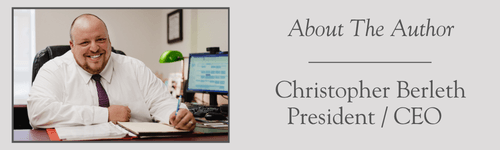
Chris Berleth Columbia Montour Chamber of Commerce CEO/President
Last week at the U.S. Chamber Institute for Organization Management, I heard a familiar story about Chinese bamboo. It was a story I’ve heard before, but it landed differently this time.
For years, the grower waters the soil and tends the ground, yet very little appears above the surface. Then the bamboo begins to grow at an extraordinary pace.
The growth may look sudden, but it is not. Long before it becomes visible, the plant is developing the root system needed to support what comes next.
What looks sudden usually isn’t. What looks simple on the surface is often the result of steady work underneath.
That lesson applies to chambers of commerce, particularly when it comes to advocacy.
Advocacy through Institute for Organization Management
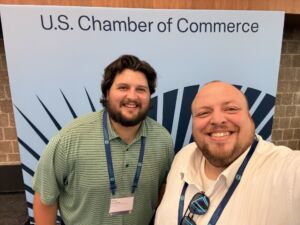
Institute for Organization Management is a professional development program of the U.S. Chamber of Commerce that brings together chamber and association professionals from across the country. The curriculum covers leadership, finance, governance, membership, communications, and advocacy. Just as valuable are the peer conversations.
Throughout the week, I had the opportunity to work alongside chamber executives representing communities of different sizes, industries, and political environments. We compared challenges, discussed ideas, and shared experiences about what it takes to lead an effective organization.
The details vary from one community to another, but the fundamentals are often the same. Strong chambers listen to their members. They build relationships before those relationships are needed. They earn credibility by being prepared, consistent, and constructive. They also understand that meaningful progress rarely comes from one meeting, one letter, or one conversation.
That is especially true in advocacy.
Advocacy is sometimes misunderstood as showing up in Harrisburg or Washington to argue for or against a bill. That is part of the work, but it is only one part.
Lobbying is the specific act of asking lawmakers to support, oppose, or amend legislation. Truth be told, we don’t do a lot of lobbying. That’s really the purview of political action committees, especially our friends in the state and U.S. Chambers. Advocacy is broader. It includes educating public officials, sharing the experiences of employers, supporting worthwhile projects, building coalitions, convening conversations, and making certain that business voices are heard before decisions are made.
Often, the most important advocacy happens quietly.
It happens when a member tells us about a regulation that is causing an unintended problem. It happens when employers identify a shared challenge involving childcare, transportation, workforce development, energy, taxes, permitting, or infrastructure. It happens when we bring those experiences to elected officials and community partners who may not otherwise understand how a policy is working in practice. It also happens when we create opportunities for people to know one another before a difficult issue arises.
One of the best recent examples was the success of our Municipal Appreciation Night.
Advocacy Through Municipal Appreciation Night
The evening brought business leaders and municipal officials together in a setting that was not focused on a crisis, a public hearing, or a specific policy dispute. Instead, it gave
us an opportunity to recognize those who serve our communities and to strengthen the relationships between local employers and the officials making decisions that affect them.
Municipal leaders oversee issues involving infrastructure, zoning, permitting, public safety, transportation, downtown development, and community investment. Employers bring firsthand knowledge of workforce needs, customer activity, business expansion, and the obstacles that can prevent an investment or project from moving forward.
Those perspectives need to meet more often.
Thanks to Geisinger, our Premier Sponsor, Municipal Appreciation Night created space for that to happen. It reminded us that advocacy does not always begin with a position paper or formal request. Sometimes it begins with a conversation, a handshake, and a better understanding of the people on the other side of an issue.
These relationships are part of the root system beneath effective advocacy.
Over the past several years, the Columbia Montour Chamber of Commerce has worked to strengthen those roots. We have become more deliberate about identifying the issues affecting our members, more consistent in communicating those concerns, and more intentional about building relationships with officials and organizations positioned to help address them.
Transportation remains both a workforce issue and an economic development issue. Roads, public transportation, drainage systems, and other infrastructure affect whether employees can reach work, whether businesses can move products, and whether communities can attract investment.
Childcare continues to limit the ability of some employers to recruit and retain workers. Workforce development requires stronger connections among businesses, schools, training providers, students, and families. Permitting, regulations, energy costs, taxes, and public investment all influence whether local employers can compete and grow.
These are complicated challenges. None will be solved through a single event or legislative session. They require good information, strong partnerships, and continued attention.
That is why we need to hear from our members.
Advocacy in Columbia & Montour
Tell us what is affecting your business. What is making it harder to hire, invest, expand, or serve your customers? Which policies are working well? Which ones are producing unintended consequences? What concerns are developing that may not yet be receiving attention?
Our advocacy agenda cannot be shaped only by headlines coming from Harrisburg or Washington. It must be grounded in the experiences of employers here in Columbia and Montour counties.
When members share those experiences with us, they give the Chamber more than an issue to discuss. They give us the information we need to identify common challenges, educate public officials, build partnerships, and advocate for practical solutions.
We also want to give our members opportunities to better understand the political and policy environment in which those decisions are being made.
Upcoming Advocacy Efforts
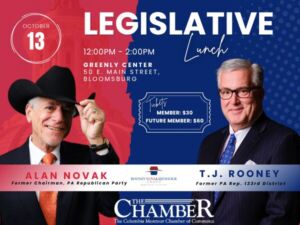
On October 13, our next Legislative Lunch will feature T.J. Rooney and Alan Novak for a discussion about the political outlook for Pennsylvania and the nation.
Rooney and Novak come from different political parties and hold different perspectives. They also demonstrate something that feels increasingly rare in American public life. People can disagree, even strongly, without treating one another as enemies.
They represent the broad and often overlooked center of Americans who hold sincere differences of opinion, but who can still listen, speak respectfully, share a laugh, and work together where common ground exists.
That is the kind of conversation we want to host.
The event will not be about political theater or trading rehearsed talking points. It will offer honest analysis, principled disagreement, mutual respect, and a clearer understanding of what the political environment may mean for employers and communities.
Additional details and registration information for the October 13 Legislative Lunch are out now!
Stay Involved
In the meantime, I encourage you to engage with us. Bring us your questions, concerns, and experiences. Help us understand where government policy and business reality are colliding.
The Chamber cannot effectively represent a business community it does not hear from. Your voice gives our advocacy direction, credibility, and strength.
Like the bamboo, the results may not always be immediately visible. Relationships take time to develop. Ideas often need to be repeated. Trust must be earned before it can be relied upon.
But when the roots are strong and the work continues, growth eventually breaks through the surface.